

LDRA software tools and services deliver increased developer productivity and software quality while reducing overall project schedule and cost. The LDRA tool suite is a flexible platform for producing safety, security, and mission-critical software in an accelerated, cost effective and requirements driven process. The tool suite’s open and extensible architecture integrates software life-cycle traceability, static and dynamic analysis, unit test and system-level testing on virtually any host or target platform.
The LDRA tool suite may be deployed “as is” to create a tailored verification workflow, or as the foundation for one of LDRA’s domain-specific Productivity Packages. In either scenario, it delivers the depth, automation, and visibility required to improve productivity and ensure consistent, auditable software assurance.
The LDRA tool suite streamlines software assurance by unifying static and dynamic analysis, requirements traceability, and verification management within a single environment.

It simplifies the process and reduces the burden on engineering teams – from managing requirements traceability, through coding standards compliance and structural coverage analysis, to producing audit-ready documentation.
Flexible across industries and development approaches, it supports continuous compliance and provides a clear, consolidated view of verification progress from requirements to release and beyond.
The LDRA tool suite maintains end-to-end traceability between requirements, code, tests, and results, providing a single point of reference for verification evidence. By linking each artefact across the lifecycle, it ensures that changes are tracked, dependencies are visible, and coverage of all objectives can be demonstrated.
Its integrated reporting consolidates this information into an audit-ready format, promoting consistency across teams and helping organisations maintain confidence in their assurance processes.
The LDRA tool suite integrates dynamic structural coverage analysis at unit, integration, and system levels, providing a complete view of test effectiveness. It supports all key coverage metrics (such as statement, branch, and modified condition/decision coverage (MC/DC)) and correlates results directly with requirements, test cases, and source code.
By centralising coverage data alongside static and dynamic analysis results, the tool suite delivers a consistent, traceable picture of verification completeness. This enables teams to identify untested logic, assess the adequacy of their test suites, and produce audit-ready evidence for safety and cybersecurity compliant works in accordance with (for example) ISO 26262 & ISO/SAE 21434, DO-178C & The Aerospace Security Framework, and IEC 61508 & IEC 62443-4-1.
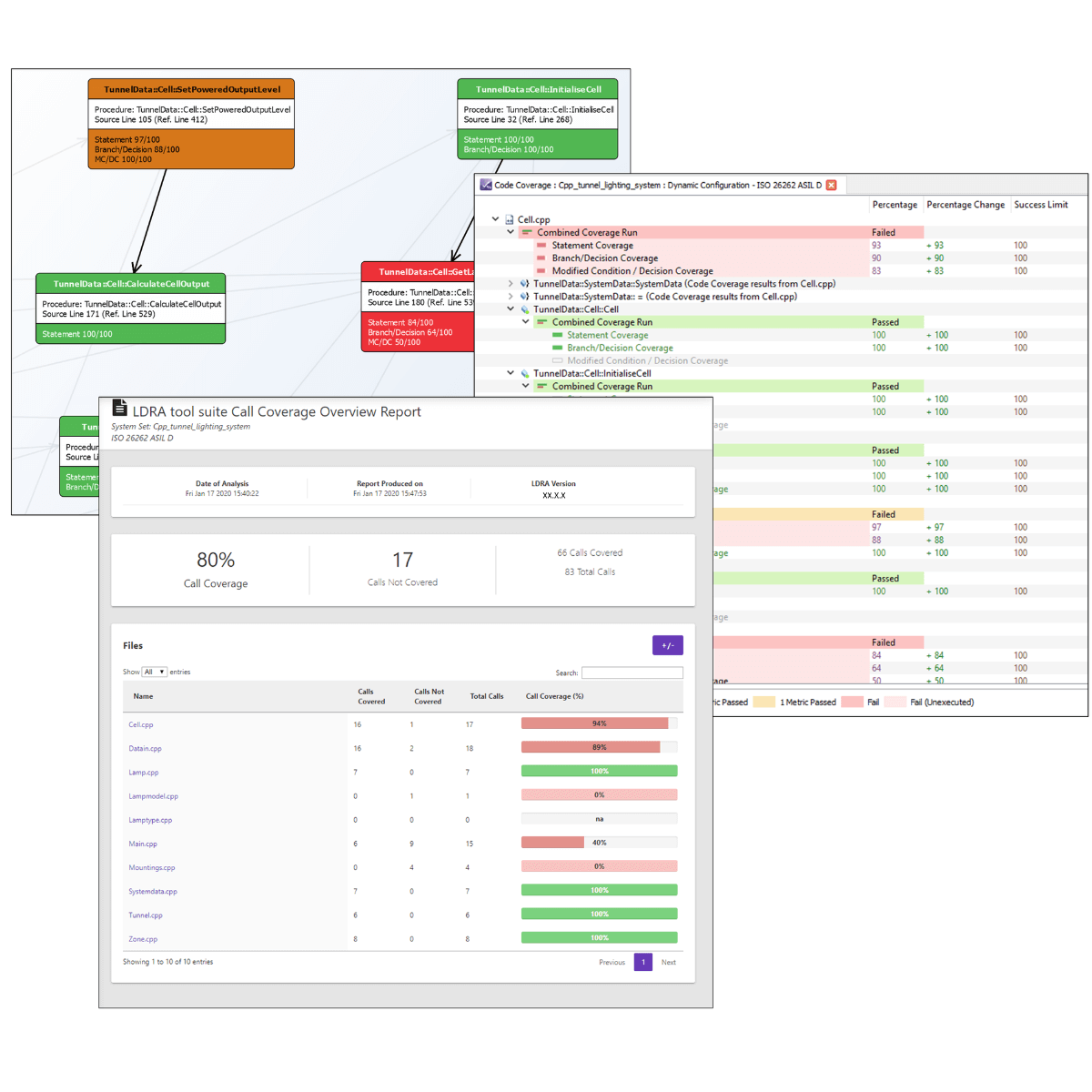
When extended with web-based reporting through optional components such as LDRAvault, coverage and traceability information can be shared securely across sites and teams, maintaining configuration control and supporting efficient, distributed verification workflows.
By correlating results from static and dynamic analysis with requirements and design artefacts, the tool suite helps confirm that code behaviour accurately reflects design intent. This capability supports objectives defined in standards such as EN 50716 (superseding EN 50128) for railway applications, IEC 62304 for medical device software, and the ECSSEST40C and ECSSQST-80C standards for space software engineering and product assurance. Each requires evidence that software structure and execution remain consistent with system-level safety, quality, and reliability goals.
The LDRA tool suite also verifies that software implementation aligns with its intended architecture and design by analysing data and control coupling (DCCC) throughout the codebase. These analyses expose unexpected dependencies, unintended functionality, and other implementation issues that could compromise system integrity or diverge from design constraints.
Optional data and control coupling coverage reports provide clear, auditable evidence of compliance, strengthening assurance arguments and helping teams demonstrate freedom from interference between software components.
For most development governed by IEC 61508 and its derived standards, TÜV approval of the LDRA tool suite provides sufficient assurance that its analysis and test results can be trusted without additional qualification. This allows teams to deploy the tool suite with confidence for all but the most critical applications, significantly reducing the qualification burden.
In sectors or projects where TÜV approval alone is not accepted – such as those operating under DO-178C, or the most critical applications developed in accordance with ISO 26262 or EN 50716 (superseding EN 50128) – the LDRA tool suite is supported by comprehensive Tool Qualification Support Packs (TQSPs). These packs provide the evidence, documentation, and example verification procedures needed to demonstrate tool confidence in use.
Although DO-330 and ISO 26262 are the only standards that formally define tool qualification processes, the methods they describe are widely recognised as good practice across other domains. The LDRA TQSPs therefore enable organisations in medical, rail, energy, space, and other critical sectors to apply the same proven approach, tailoring it to their own regulatory environment while maintaining a consistent, auditable framework for tool assurance.
Achieving software assurance through manual reporting and ad-hoc communication can feel a bit like trying to share a bowl of rice pudding across several tables – messy, inefficient, and likely to end in arguments about who’s got the spoon. The LDRA tool suite replaces that confusion with a single, centralised verification environment that everyone can see and trust.
By integrating requirements traceability, static and dynamic analysis, and reporting within one platform, it gives all stakeholders a consistent view of progress and compliance. Project-level reporting unifies data from multiple engineers, tools, and sites, maintaining configuration control and ensuring that each team works from the same verified source of information.
Optional extensions such as LDRAvault enhance this collaboration further, providing web-based reporting, version control, and audit traceability for complex or multi-site developments. The result is a coordinated workflow where development, verification, and compliance teams can share evidence seamlessly – without anyone losing their spoon.
When a real-time system behaves unpredictably, it’s rarely a pleasant surprise. The LDRA tool suite helps developers avoid such uncertainty by analysing timing behaviour to confirm that software executes within defined limits under both nominal and worst-case conditions.
Optional add-on capabilities such as Worst-Case Execution Time (WCET) analysis enable early evaluation of timing margins at component level and comprehensive end-to-end assessment once the system is integrated. These capabilities are particularly valuable for applications running on multicore processors (MCPs), where resource contention, cache effects, and shared bus access can make timing verification far more complex than in single-core environments.
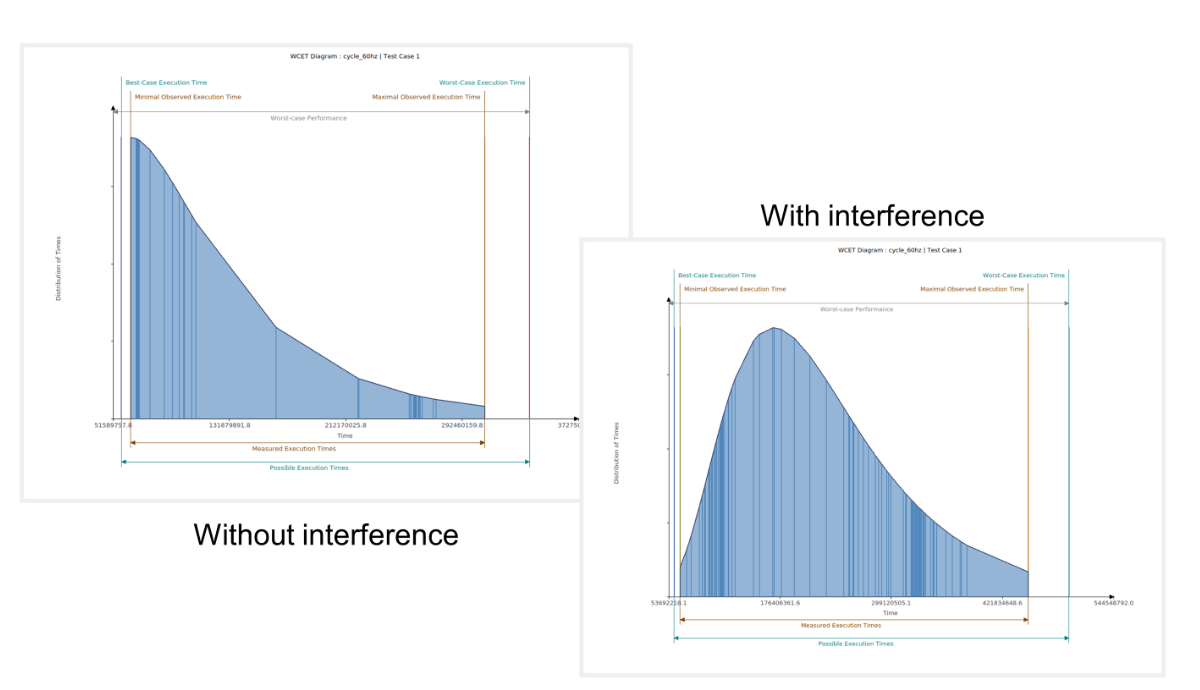
By combining timing analysis with functional verification and coverage assessment, the LDRA tool suite provides a holistic view of both what the software does and when it does it.
As systems become more interconnected, safety and cybersecurity must work together to ensure that communication between components and networks remains correct, reliable, and resilient to attack. The LDRA tool suite analyses data and control flow across interfaces to help in the detection of unintended dependencies, information leakage, or unsafe interactions.
Optional taint analysis traces the movement of untrusted or external data through the system to expose vulnerabilities such as injection paths or privilege escalation before they can compromise integrity. Static and dynamic analyses confirm that interactions behave as designed, meeting the expectations of standards including ISO/SAE 21434, IEC 62443-4-1, and DO-326B.
In short, the LDRA tool suite gives developers confidence that data stays exactly where it should — not wandering into another process space, nor being coaxed there by malicious intent.
As software evolves through updates or configuration changes, it must be shown that assurance has been preserved. The LDRA tool suite maintains traceability between requirements, source code, tests, and results so that any change can be quickly assessed for its impact on safety, reliability, or security.
Automated change-impact analysis and selective re-verification regenerate only the evidence affected by a modification, avoiding unnecessary retesting while preserving confidence in compliance. Optional extensions such as LDRAvault simplify configuration management and reporting, helping teams maintain demonstrable assurance across updates, patches, and continuous delivery cycles.
Modern systems blend safety-critical control with extensive connectivity, making it essential that safety and cybersecurity assurance progress together rather than in isolation. The LDRA tool suite provides a unified verification framework that links safety- and security-related evidence from requirements through analysis, testing, and reporting.
By maintaining consistent traceability and applying shared verification workflows, it enables teams to demonstrate that safety mechanisms are not weakened by security controls — and that security measures do not introduce new functional risks. This integrated approach supports compliance with complementary standards such as ISO 26262 and ISO/SAE 21434 in automotive, IEC 61508 and IEC 62443 in industrial domains, and DO-178C with DO-326B in aerospace.
The LDRA tool suite tackles the recurring challenges faced by software development teams working under safety, security, and quality constraints. By unifying verification, analysis, and reporting in one environment, it eliminates tool fragmentation, reduces manual effort, and ensures that compliance evidence is always complete, consistent, and ready for audit.
The LDRA tool suite unifies these activities within a single integrated environment. It links requirements, source code, analysis, and tests so that verification evidence flows seamlessly between them, removing duplication and reducing the risk of inconsistency. The result is a coherent, end-to-end view of project assurance without the friction of managing multiple disconnected tools.
The LDRA tool suite automates test management and execution, integrating test results directly with coverage data and requirements traceability. Regression testing is easily achieved by re-running stored tests, ensuring that new or modified code can be verified quickly and repeatably. Reports are produced automatically in audit-ready formats, reducing manual effort and ensuring that evidence remains complete and consistent throughout the lifecycle.
The LDRA tool suite automates the generation and organisation of verification evidence, providing traceability from requirements through code, tests, and results. Certification-focused reports are created directly from project data, ensuring that every objective is clearly supported by verifiable evidence. This structured, standards-aligned approach simplifies audit preparation and helps teams demonstrate compliance efficiently, even under the scrutiny of rigorous certification authorities.
The LDRA tool suite supports a “shift-left” approach by detecting defects and vulnerabilities early in development through comprehensive static and flow analysis. This enables teams to identify and correct potential safety or cybersecurity issues before they propagate into later stages, where remediation becomes more costly and disruptive. By integrating verification throughout the lifecycle, the tool suite helps maintain software quality, security, and compliance from the first line of code onwards.
The LDRA tool suite enforces consistent coding standards across teams through automated compliance checking against published rulesets such as MISRA C/C++, CERT C/C++, and CWE. It also supports the definition of project- or organisation-specific rules, ensuring that internal guidelines are applied uniformly. By providing clear, actionable reports that identify violations and their impact, the tool suite promotes code consistency, maintainability, and audit readiness across distributed development teams.
The LDRA tool suite provides complete bidirectional traceability between requirements, source code, test cases, and verification results. This ensures that every requirement is implemented, tested, and verified – and that any untested or orphaned code can be quickly identified. Combined with structural coverage analysis, it delivers a transparent view of verification completeness, enabling teams to demonstrate that all code paths are exercised and that each requirement is fully validated.
For larger or geographically distributed projects, LDRAvault extends these capabilities with centralised data management and web-based reporting, ensuring that verification evidence remains consistent and accessible across multiple teams and sites.
The LDRA tool suite reduces certification rework by integrating verification and compliance activities throughout the development lifecycle rather than deferring them to the end. Continuous analysis, testing, and reporting ensure that issues are detected and resolved as they arise, keeping artefacts current and aligned with evolving requirements.
Because verification evidence is generated automatically and maintained incrementally, projects always stay audit-ready – eliminating the costly rush to reconstruct documentation and test results late in the programme.
This LDRA tool suite brings together the tools and capabilities needed to manage the complexity of modern safety- and security-critical software development.

The LDRA tool suite is LDRA’s flagship platform for building quality and assurance into software from requirements through to deployment. It provides an open, extensible environment that supports complete lifecycle verification — combining requirements traceability, coding standards compliance, static and dynamic analysis, unit, integration and system-level testing, and comprehensive certification and compliance reporting.
Used across safety-, security-, and mission-critical sectors, the LDRA tool suite helps development teams demonstrate compliance with the most demanding standards, including:
The core components of the tool suite can be configured to meet diverse project and process needs, while an extensive range of optional add-ons provides flexibility for domain-specific assurance or integration. The same technologies also form the foundation of LDRA’s domain-specific Productivity Packages, which deliver preconfigured solutions aligned with individual sector standards.
The LDRA tool suite is built around a set of core components that together provide complete lifecycle analysis, testing, and verification capability. These components can be used individually or in combination to create a unified, standards-aligned verification environment.
Together, these components integrate seamlessly to automate verification tasks, enhance visibility across the software lifecycle, and provide the evidence required to demonstrate compliance with functional safety, cybersecurity, and quality standards.
A wide range of optional add-on components extend the LDRA tool suite to address specific verification, compliance, and integration needs. These modules can be combined to tailor the environment to the requirements of individual projects or domains.
Verification and coverage extensions
Standards and compliance support
Traceability, reporting, and collaboration
Tool qualification and integration
These extensions enable the LDRA tool suite to scale from standalone verification environments to enterprise-wide assurance frameworks, adapting to the needs of any safety, security-, or mission-critical software development programme.
The LDRA tool suite embodies more than fifty years of continuous refinement in software verification and test automation. Its mature architecture integrates static and dynamic analysis, requirements traceability, and automated testing within an open, extensible framework.
This combination of proven reliability and ongoing innovation provides a consistent foundation for the development and verification of safety-, security-, and mission-critical software.
The LDRA tool suite applies both static and dynamic analysis techniques to identify issues early and confirm behaviour at run time.
Together, these complementary approaches deliver comprehensive visibility into code quality, reliability, and robustness throughout the development life cycle.
Reporting from both static and dynamic analyses is clear, configurable, and designed to support auditable verification. Results can be viewed interactively within the tool suite or exported for inclusion in project documentation and certification evidence.
Optional extensions enhance these capabilities with features such as:
Together, these functions provide a complete environment for demonstrating software quality and assurance, whether for internal governance or external compliance.
Both LDRA and the LDRA tool suite are certified. LDRA has maintained ISO 9001 certification for over 25 years. The LDRA tool suite is approved by SGS-TÜV Saar and TÜV SUD for the following functional safety standards:
In addition, tool qualification support packs (TQSPs) are available to simplify demonstrating compliance with functional safety standards such as DO-178C that do not permit the use of certificates from certifying organizations.
Here is a partial list of the languages and platforms currently supported by the LDRA tool suite. Please contact us for a complete list of languages and platforms supported by the LDRA tool suite:
| Source Code Languages |
|---|
| C |
| C++ |
| Java |
| Ada95 |
| Manufacturer Name | Processor Name | Compiler/Tool Chain |
|---|---|---|
| Atmel | ATmega128 | WinAVR |
| Atmel | TSC695 (ERC32) | GNU |
| Intel | 80×86 | MASM |
| Intel | 80C196 | Intel |
| Intel | MCS251 | Intel |
| NXP | MPC5674 | WRS Diab |
| NXP | MPC603e | WRS Diab |
| NXP | MPC603e | GNU |
| NXP | MPC74XX | GHS MULTI |
| NXP | MPC74XX | GHS AdaMULTI |
| NXP | MPC74XX | GHS MULTI |
| NXP | MPC8260 | WRS GNU |
| NXP | MPC8349E | GHS MULTI |
| NXP | MPC85XX | EDS |
| NXP | MC68HC11 | EDS |
| NXP | MC68881 | Cosmic C Cross Compiler for S12X |
| NXP | MC9S12 | WRS Diab |
| NXP | P1011 | Microchip MPLAB XC Compiler |
| Microchip | dsPIC®33 | DDC-I TADS – 1750A 6.1 |
| MIL | RH-1750A | PSS C17 Integrated Tool Set |
| MIL | RH-1750A | IAR |
| NXP | LPC2294HBD144 | GHS MULTI |
| PMC-Sierra | MIPS MSP 8520 | TI CCS |
| TI | TMS320C2xxx | TI CC |
| TI | TMS320C3x |
| Host Platforms |
|---|
| Windows 11/10/8/7/Vista/XP |
| Linux (RHEL/CentOS, Ubuntu, SUSE/openSUSE) |
| MAC |
| Development Tools |
|---|
| Altera |
| Analog Devices VisualDSP |
| Atego ObjectAda |
| Atmel Studio |
| ARM DS-5 Development Studio |
| Cosmic ZAP & IDEA |
| DDC-I Open Arbor |
| Freescale CodeWarrior |
| GNU |
| Green Hills MULTI & INTEGRITY |
| IAR Embedded Workbench |
| Keil µVision |
| Lauterbach TRACE32 |
| MathWorks Simulink |
| Mentor Graphics |
| Microchip MPLAB & MPLAB X |
| QNX Momentics |
| Renesas |
| STM32Cube |
| TASKING winIDEA |
| TASKING |
| TI Code Composer Studio |
| Wind River Tornado, Workbench supporting VxWorks, Diab |
| Xilinx |
| Supported Microprocessors and Microcontrollers |
|---|
| Altera – NIOS, ARM, Agilex ARM Cortex-Axx |
| Analog Devices – SHARC, Blackfin, ADSP-xxx, ARM |
| ARM Cortex A/R/M |
| Infineon – TriCore, C166, ARM, MOTIX, XMC, TRAVEO, AURIX |
| Intel – 8051, 80C196, x86, x64 |
| Microchip / Atmel – PIC, dsPIC, ATmega, SAM, RISC-V |
| NXP / Freescale – LPCxxxx, S32, HCxx, MC68K, MPC5xx, 6xx & 8xx |
| NXP i.MX, LAxxxx, LSxxxx, LXxxxx, S08, S16 |
| NVIDIA – Grace CPU |
| PowerPC – 5xx, 6xx, 7xx & 8xx |
| Renesas – RH850, RL78, RX, ARM, RISC-V |
| ST – STM32, SPC5, Stellar |
| TI – MSP430, TMS320, TMS570, ARM Cortex-Mx, ARM Cortex-Rx, ARM Cortex-Axx, xxC6xxxx |
Email: info@ldra.com
EMEA: +44 (0)151 649 9300
USA: +1 (855) 855 5372
INDIA: +91 80 4080 8707