How does the LDRA Productivity Package for Industrial Controls help with compliance challenges?
This LDRA Productivity Package addresses the challenges that make compliance with functional safety and cybersecurity standards demanding and resource-intensive across the development lifecycle – up to and including Safety Integrity Level 4 (SIL 4) as defined by IEC 61508.
The package brings together LDRA’s best-in-class capabilities for the development and verification of industrial controls software. Its flexibility and scalability support the evolving needs of complex projects and promote collaboration across large and small teams alike, making it suitable for use at any stage of the software lifecycle.
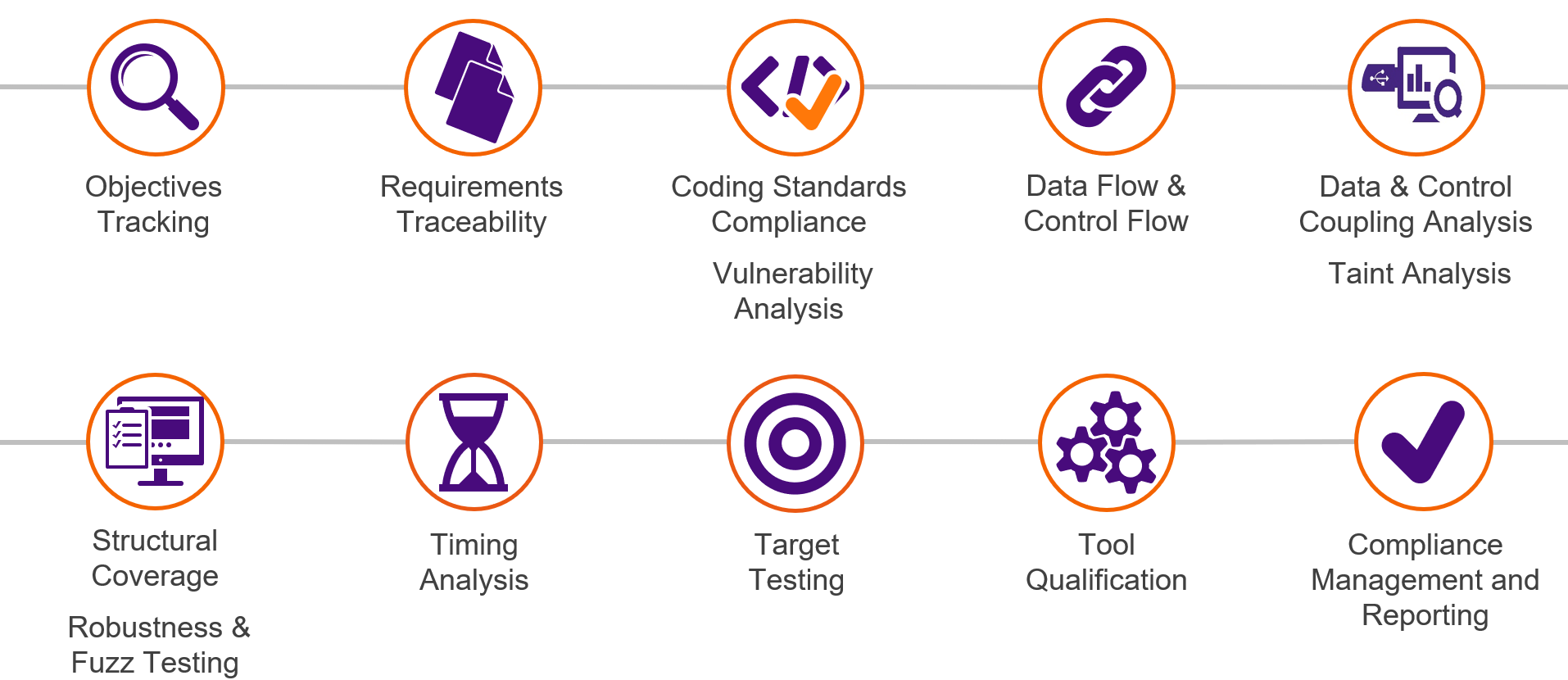
It simplifies key verification activities, such as
In doing so, the package reduces the compliance burden on engineering teams. Its comprehensive feature set also makes it equally applicable to industrial process control software developers, automation suppliers, and equipment manufacturers developing software to varying levels of functional safety and cybersecurity assurance.
Who might use the LDRA Productivity Package for Industrial Controls?
The LDRA Productivity Package for Industrial Controls is suited to a wide range of organizations involved in industrial automation software development. These include industrial control system vendors delivering configurable, off-the-shelf platforms, as well as any industrial controls company developing bespoke applications for individual factories or production lines.
Across this community, where C and C++ remain the dominant implementation languages, developers share a common need to ensure that software is reliable, secure, and maintainable throughout its lifecycle, often through compliance with appropriate standards. As the growth of industrial controls online connectivity continues to transform how systems communicate and integrate, these priorities are becoming ever more critical to safety, cybersecurity, and operational integrity.
How can consistency and visibility be maintained in industrial control software verification?
The LDRA Productivity Package for Industrial Controls presents a unified view of verification progress across the entire project. Results from static and dynamic analysis, coverage measurement, and traceability are presented in a consistent format, giving teams clear visibility of compliance evidence at every stage of development.
This centralised approach supports disciplined configuration management and enables collaboration between developers, testers, and quality or compliance engineers, even when they are distributed across multiple sites. It also consolidates evidence to strengthen the oversight of complex supply chains and simplify the reuse of proven code in related products or system variants.
For organizations managing larger programmes, the addition of LDRAvault provides enterprise-level data management and reporting to ensure that compliance activities remain aligned with IEC 61508 and IEC 62443-4-1 objectives throughout the project lifecycle – even across multiple sites.
How can MC/DC coverage be demonstrated in industrial control software?
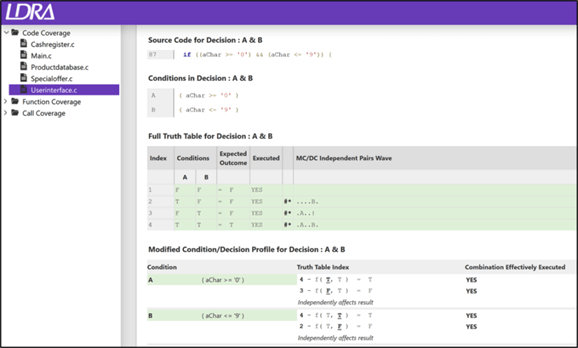
The LDRA Productivity Package for Industrial Controls includes built-in support for dynamic structural coverage analysis, including MC/DC. Used alongside requirements-based testing, it enables users to
- Assess coverage from unit level through to complete system validation
- Examine results to highlight and address any areas of incomplete testing
- Produce the evidence required to demonstrate IEC 61508 compliance up to SIL 4
All measurement, traceability, and reporting functions are integrated within the package, resulting in a clear and repeatable means of verifying that test activity is both comprehensive and aligned with safety objectives.
How can implemented industrial control code be shown to match design intent?
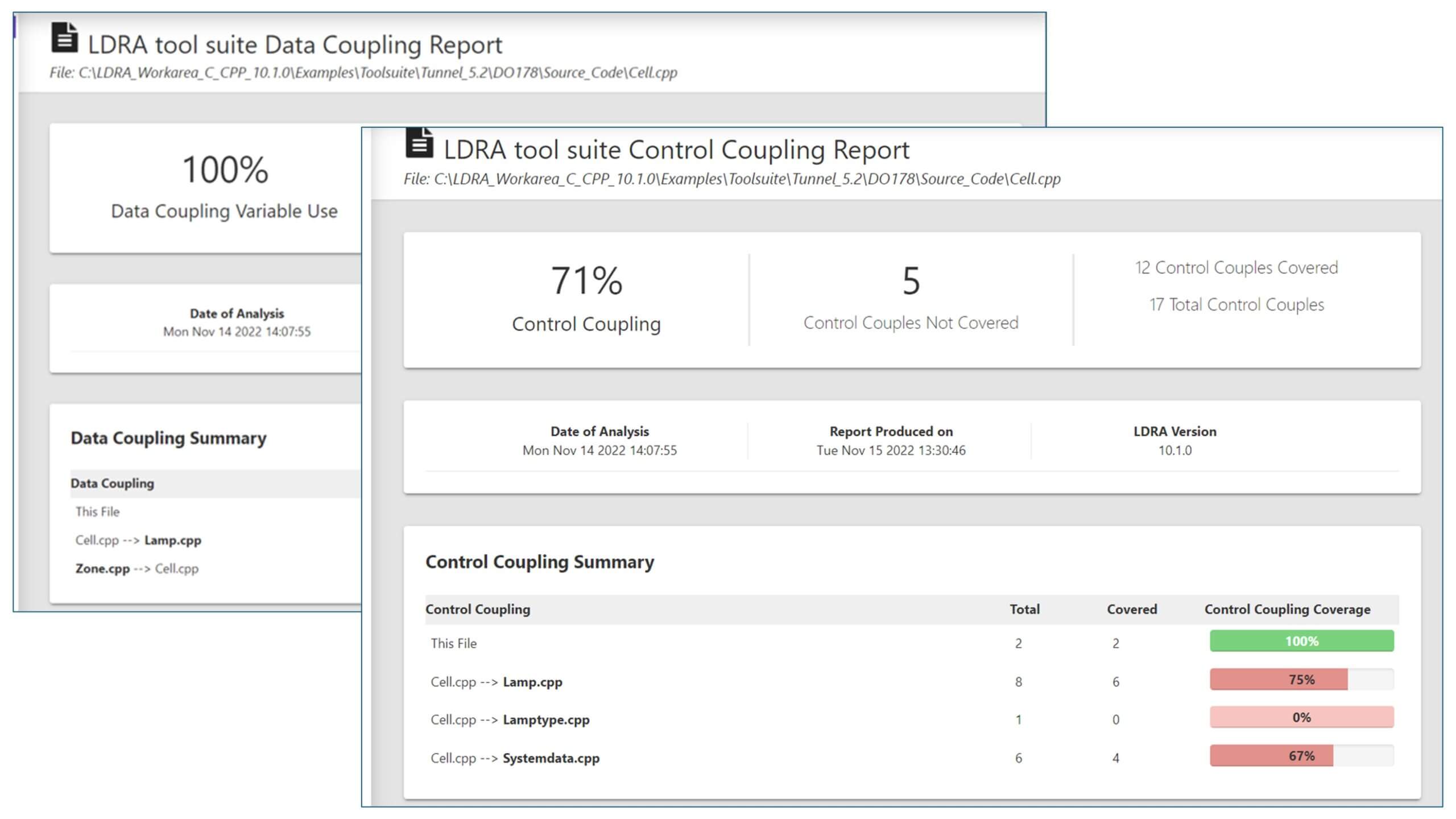
IEC 61508-3 7.4.9 requires that verification shall be carried out to demonstrate that the software design and implementation are consistent and that the software is free from unintended functions. Achieving this alignment is essential to showing that safety-related functions operate as specified and that component interactions remain predictable under all operating conditions.
Although IEC 61508 does not explicitly refer to data and control coupling analysis, they provide examples of how the LDRA Productivity Package for Industrial Controls supports the objectives of 7.4.9. The analysis of information and control flows between components helps verify that implementation remains consistent with the intended architecture and free from hidden dependencies.
This capability provides clear evidence of architectural integrity in support of IEC 61508 compliance up to, and including, SIL 4.
How can collaboration between automotive developers, testers, and compliance teams be coordinated?
The LDRA Productivity Package for Industrial Controls integrates requirements traceability, verification management, and reporting aligned with IEC 61508 and IEC 62443-4-1. This provides all stakeholders with a single, trusted source of verification evidence, ensuring that development, test, quality, and compliance activities remain coordinated and transparent throughout the project lifecycle.
By unifying verification data and documentation within one environment, the package strengthens audit readiness, promotes collaboration across multi-site teams, and supports the consistent application of functional safety and cybersecurity processes from design to deployment.
How can safe and secure industrial control software connectivity be assured?
Industrial control systems increasingly rely on connected architectures that link operational technology with enterprise networks, remote interfaces, and cloud-based services. IEC 62443-4-1 defines the need for secure development processes that prevent unintended interference and maintain both functional and cybersecurity integrity.
The LDRA Productivity Package for Industrial Controls supports these objectives by combining functional safety verification with integrated security analysis. Capabilities such as data and control flow checking, compliance with secure coding standards including CERT and CWE, and optional taint analysis help identify vulnerabilities and confirm that data exchanges behave as intended.
By embedding these checks within the wider verification process, the package helps ensure that safety-related software remains resilient to cybersecurity threats while maintaining compliance with IEC 61508 and IEC 62443-4-1 throughout the system lifecycle.
How can industrial control software assurance be maintained through updates and system changes?
IEC 61508 requires that any modification to safety-related software be controlled and re-verified to preserve functional integrity and maintain the assigned SIL.
The LDRA Productivity Package for Industrial Controls supports this through end-to-end traceability between requirements, code, and verification artefacts. Automated change-impact analysis and repeatable test execution allow teams to identify and re-verify only the components affected by a change. Where digital twinning or virtual commissioning is used, the same verification data and tests can be applied within the twin environment to validate changes before deployment.
This approach enables updates and reconfigurations to be implemented with demonstrable assurance, maintaining both safety and cybersecurity integrity throughout the operational life of industrial control systems.
How can safety and cybersecurity assurance be aligned across the industrial control software lifecycle?
Modern industrial systems combine safety-critical control with increasing levels of connectivity, making it essential that safety and cybersecurity assurance be managed in an integrated manner. IEC 61508 and IEC 62443-4-1 both recognise the need for coordination between these disciplines to ensure that safety mechanisms are not compromised by security measures, and that security controls do not introduce new functional risks.
The LDRA Productivity Package for Industrial Controls provides a unified verification environment that supports both safety and cybersecurity objectives. By maintaining consistent traceability from requirements through analysis, testing, and reporting, it aligns safety- and security-related evidence and coordinate assurance cases across the lifecycle.
These capabilities support compliance with IEC 61508 and IEC 62443-4-1, helping to demonstrate that safety and security requirements are applied coherently throughout the development, deployment, and maintenance of industrial control software.
How can software verification support functional safety within complex control architectures?
Industrial machinery increasingly depends on multiple controllers and embedded devices working together to deliver coordinated safety functions. The LDRA Productivity Package for Industrial Controls provides analysis and testing capabilities that help verify these interactions and confirm that safety-related behaviour remains predictable.
Data and control coupling analysis, together with requirements-based testing and structural coverage measurement, ensures that control logic behaves as intended and that communication between software modules is free from unintended dependencies. Optional taint analysis capabilities extend that functionality to provide a cybersecurity focus on those communication streams. These features are used to demonstrate of freedom from interference and verify consistent, reliable behaviour in accordance with IEC 61508 and related machinery-safety standards such as IEC 62061.
How can cybersecurity be incorporated without disrupting existing safety certification?
Adding cybersecurity features to safety-related machinery depends on how the original software was developed.
If the control software was created and verified using the LDRA tool suite, the LDRA Productivity Package for Industrial Controls enables IEC 62443-4-1 objectives to be integrated without requalifying the entire system. Existing traceability and test artefacts can be updated to show that new security controls do not compromise safety functions.
For legacy software developed outside the LDRA environment, a verification baseline can be established through reverse engineering. Using optional tools such as TBextreme, tests can be generated automatically from existing code to confirm that its functional behaviour remains unaffected. Combined with the package’s analysis and reporting features, this approach provides clear evidence that added cybersecurity measures have not introduced unintended effects.
Together, these capabilities allow safety and cybersecurity assurance to be aligned efficiently while maintaining compliance with IEC 61508 and IEC 62443-4-1.
How can verification activities scale across multi-supplier machinery projects?
IEC 61508 acknowledges that large automation programmes often involve several equipment suppliers or subsystem contributing to a shared safety architecture. For example,
- IEC 61508-1, Clause 7.1.2 requires that “interfaces between different organizations involved in the safety lifecycle shall be defined and documented.”
- IEC 61508-1, Clause 6.2.16 states that “where parts of the E/E/PE system are developed or supplied by different organizations, responsibilities and authorities shall be defined.”
The scalability of the LDRA Productivity Package for Industrial Controls ensures a unified environment for static and dynamic analysis, enabling consistent application of IEC 61508 verification objectives across all participating organizations.
Using project-level reporting and optional LDRAvault integration, verification results and traceability data from different contributors can be consolidated into a single, auditable record. This supports end-to-end visibility, simplifies compliance review, and helps ensure that safety evidence from all software suppliers aligns with the overall system safety case.
Understanding the LDRA Productivity Package for Industrial Controls
This LDRA Productivity Package brings together the tools and capabilities needed to manage the complexity of modern safety- and security-critical controls software development
What are the LDRA Productivity Packages?
LDRA Productivity Packages are bundles that combine LDRA’s static and dynamic analysis, certification-focused reporting, and optional extensions like requirements traceability and tool qualification. Each package is purpose-built and preconfigured to address the expectations of specific industries and standards, supporting goals ranging from functional safety and software quality to cybersecurity assurance. By providing a ready-to-deploy, scalable framework, they help development teams achieve compliance more efficiently while enhancing consistency and overall software productivity.
How does the LDRA Productivity Package for Industrial Controls build upon traditional LDRA tools?
The LDRA Productivity Package for Industrial Controls brings together long-established, field-proven components of the LDRA tool suite, including TBvision, TBrun, and TBmanager, complemented by add-on modules selected for the needs of industrial machinery and automation software development.
Building on these proven technologies, the package provides additional value through preconfigured workflows aligned with IEC 61508 Safety Integrity Levels (SILs) and IEC 62443-4-1 cybersecurity objectives. This ready-to-deploy configuration accelerates implementation, reduces the need for tool customisation, and ensures consistent application of functional safety and security verification requirements.
On installation, the package enforces the correct objectives, metrics, and reporting structures for IEC 61508 and IEC 62443-4-1, enabling rapid, uniform adoption across development teams and projects. Its capabilities also support related standards such as IEC 62061 and ISO 13849‑1, which apply the principles of IEC 61508 to machinery control systems using Safety Integrity Levels (SILs) and Performance Levels (PLs) respectively to define the required degree of risk reduction.
What does the LDRA Productivity Package for Industrial Controls offer?
The LDRA Productivity Package for Industrial Controls provides a comprehensive, preconfigured tool suite tailored to the demanding needs of safety- and reliability-critical automation software. By integrating advanced static and dynamic analysis with requirements traceability and verification management, it streamlines the development and qualification of industrial control applications in accordance with standards such as IEC 61508 and IEC 62443-4-1. This enables engineering teams to demonstrate compliance efficiently, improve software quality, and maintain confidence in system integrity throughout the product lifecycle.
The package offers:
- Functional safety and security standards compliance with IEC 61508 and IEC 62443-4-1.
- Static code analysis including key quality, complexity and testability metrics.
- Coding standards compliance including those published by MISRA, CERT, and CWE for both C and C++, along with many other commercially available coding standards.
- The ability to define custom coding standards.
- Dynamic structural coverage analysis including MC/DC.
- Unit, integration, and system level testing on target hardware.
- Requirements-based and on-target
- Security analysis and reporting, including taint analysis.
- Data coupling and control coupling
- Can be extended through add-on capabilities including requirements traceability, web-based project-level reporting, worst-case execution time analysis, and tool qualification packages.
- Breadth of capabilities meets the needs of most industrial control software development and verification projects.
- Flexibility and scalability to support control projects at any point in the lifecycle.
Together, these capabilities provide an integrated, ready-to-deploy solution that supports the full software development lifecycle. They accelerate compliance, strengthen assurance, and enhance productivity across diverse development environments, making the package equally suited to the needs of industrial control system vendors, industrial controls company teams, and independent developers creating bespoke or configurable control software solutions.
Which software analysis techniques are deployed by the LDRA Productivity Package for Industrial Controls?
The LDRA Productivity Package for Industrial Controls combines static and dynamic analysis to provide comprehensive verification against functional safety, reliability, and cybersecurity objectives.
Static analysis evaluates code quality through established metrics and enforces compliance with industry coding standards such as MISRA, CERT, and CWE, while also accommodating user-defined rule sets. These capabilities enable industrial control system vendors, industrial controls company teams, and independent developers to detect issues early, maintain code integrity, and demonstrate conformity with the stringent requirements of industrial automation and control software.
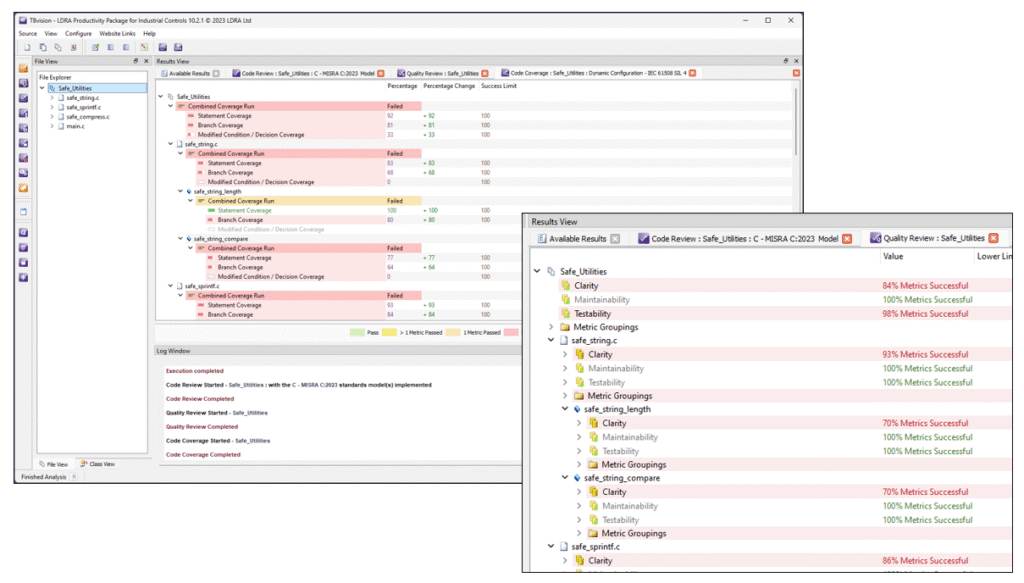
Dynamic analysis capabilities extend across unit, integration, and system-level testing – whether performed on simulators or target hardware.
- Structural coverage analysis, including MC/DC, provides clear visibility of test completeness and supports requirements-based and on-target verification.
- Analysis of data and control coupling helps confirm that software behaviour aligns with design intent, ensuring the implemented code meets the safety and reliability expectations of industrial control systems.
What reporting capabilities does the LDRA Productivity Package for Industrial Controls offer?
Reporting from both static and dynamic analyses is tailored to the expectations of the industrial automation sector and aligned with the objectives of standards such as IEC 61508 and IEC 62443-4-1. The package also automates the checking of code quality and compliance metrics across the development lifecycle, helping industrial control system vendors, industrial controls company teams, and bespoke solution developers to generate consistent, auditable evidence of conformity.
Optional extensions enhance the package with capabilities including:
- Requirements traceability
- Web-based verification and coverage reporting
- Worst-case execution time (WCET) analysis
- Taint analysis
- Tool qualification support
Together, these features provide a comprehensive toolkit for achieving the highest levels of assurance in the development of safety- and security-critical control software, supporting compliance and quality objectives from design through validation and operational deployment.