Embedded system developers facing the increasingly complex challenge of certifying embedded applications running on complex SoCs can reduce software certification costs and risks using the LDRA tool suite’s integration with PolarFire SoCs.
Manufacturers across industries are leveraging new SoCs along with advanced software technologies to develop new platforms and capabilities that are making what was once impossible now widely available. While these technologies enable innovation, the challenge of assuring these new systems are safe, reliable, and secure is becoming much more complex and costly.
Microchip and LDRA provide a robust solution where reliable hardware, secure architecture, and verified software can all work collectively to provide a future-proof foundation for building reliable and secure embedded systems. This blog highlights how the integration between the LDRA tool suite and Microchip PolarFire SoC’s can reduce software certification costs and risks.
Technology is rapidly evolving in all markets and changing our day-to-day lives. Vehicles from automobiles to heavy equipment are becoming more autonomous, and in some cases capable of operating without a human driver. Robots are used to perform tasks ranging from maintenance inspections in harsh environments to performing medical procedures on patients with precision no human can achieve. Drone applications include power line inspection, disaster prevention, and smart agriculture. In some cases, vehicles, robots and drones can even work collaboratively to perform more complex tasks. What was once science fiction is quickly becoming reality.
While the possibilities seem endless, a huge challenge in developing these systems is ensuring that they operate correctly, safely, and securely. An area of particular concern is assuring and certifying embedded software, which is compounded by the trend of increasing software content in embedded systems. Consider the average lines of software code per vehicle in 2015 was 100 million, and that number doubled by 2020. Goldman Sachs Research believes this number could reach as much as 650 million lines of code by 2025 (https://www.goldmansachs.com/insights/articles/software-is-taking-over-the-auto-industry).
In addition to driving growth in software content, the adoption of new software technologies has led to the emergence of new and newly revised safety and security regulations and standards. As a result, larger and often more distributed teams of software developers are needed to develop and verify the software. The impact of all these changes is that the level of effort, costs, and risks associated with assuring software is safe, secure, and complies with functional safety and cybersecurity standards have grown exponentially.
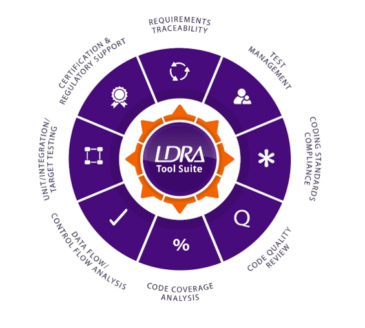
The LDRA tool suite is a flexible platform for producing safety, security, and mission-critical software in an accelerated, cost-effective and requirements-driven process. The tool suite’s open and extensible architecture integrates software life-cycle traceability, static and dynamic analysis, and unit and system-level testing. It is structured to provide eight core capabilities and is sufficiently modular to allow the provision of each to be added as the need arises.
To support large and distributed development teams, an optional web-application is available that automatically aggregates reports and results from the LDRA tool suite including (but not limited to) code reviews, code coverage analysis, and unit testing results. Imported reports and results across multiple users and projects are collected and used to generate advanced visualizations that provide actionable insight across both large and targeted sets of verification data. The automatic data aggregation is designed to support CI/CD workflows and ensures the latest results and reports are always available.
The tool suite enables safety and security critical software development teams to achieve certification or approval in accordance with rigorous standards in:
The components of the tool suite are available in several industry productivity packages that align with industry specific software development and verification needs.
LDRA’s integration with Microchip’s PolarFire RISC-V SoCs and development toolchains allows developers to verify software operates safely and securely throughout the software development lifecycle. The integration provides several capabilities including:
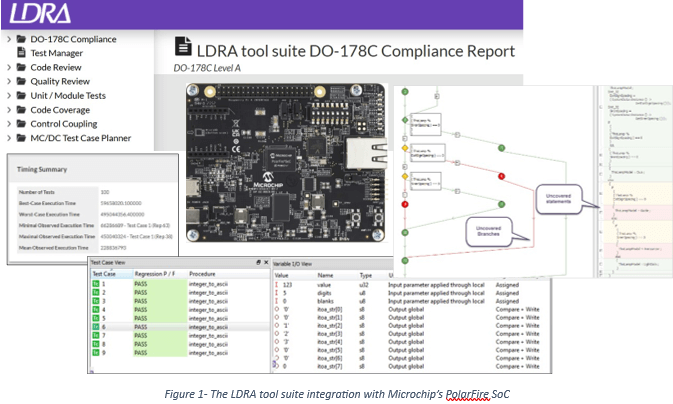
To learn more about the LDRA tool suite and its integration with Microchip’s PolarFire SoCs, please visit https://ldra.com/ or contact info@ldra.com.
Read the full article here on Microchips website Certifying Embedded Applications Running on PolarFire® SoC FPGAs | Microchip Technology
Email: info@ldra.com
EMEA: +44 (0)151 649 9300
USA: +1 (855) 855 5372
INDIA: +91 80 4080 8707