With deep roots in embedded systems testing, Software Test Group (STG) has earned a strong reputation for providing robust, scalable verification services across industries where reliability, safety, and precision are non-negotiable. From automotive and aerospace to rail, healthcare, and industrial automation, STG’s specialists are trusted to help their clients validate embedded systems against stringent functional and safety requirements.
Operating from Częstochowa, Poland, the company’s experienced engineers and testers bring both domain knowledge and practical fluency with leading test tools and standards. This combination enables STG to tailor effective, standards-compliant test strategies – accelerating development without compromising quality
That expertise was recently put to the test when STG took on a recent railway project that stood out for both its complexity and criticality. The team was tasked with providing component-level tests for a multipurpose stoneblower system – a track maintenance machine used to ensure the stability and smoothness of railway ballast.
A stoneblower is a railway maintenance machine that keeps the track level and properly supported. Instead of tamping – which packs and reshapes the existing ballast beneath the sleepers – a stoneblower gently lifts the track and injects small stone chips underneath using compressed air.
These stones fill any gaps and restore the correct alignment without disturbing the surrounding ballast. The result is a smoother, longer-lasting track surface with less wear on both rails and trains.

RAMS (Reliability, Availability, Maintainability, and Safety) ensures system dependability and safety, especially in railways. For instance, a train control system must minimize downtime (availability), reduce maintenance (maintainability), ensure reliability, and prevent unsafe conditions (safety).
Functional safety, a subset of RAMS, manages risk levels in equipment or systems. It identifies harmful conditions and corrective actions to mitigate incidents. Functional safety relies on active systems to respond to dangers. For example, if a sensor fails, the system detects it and takes actions (e.g., halting the train) to prevent accidents.
EN 50126 defines the four RAMS terms, and a systematic process for demonstrating their achievement. It is subdivided into the Generic RAMS Process and a Systems Approach to Safety.
Software specific considerations have historically been covered by EN 50128 (for railway control and protection systems), or EN 50657 (for rolling stock applications). These two software standards have now been amalgamated into the currently active EN 50716 and therefore superseded, but their principles are largely retained. Unit and component (or integration) testing, as supported by LDRAunit, are key components of compliance with these standards.
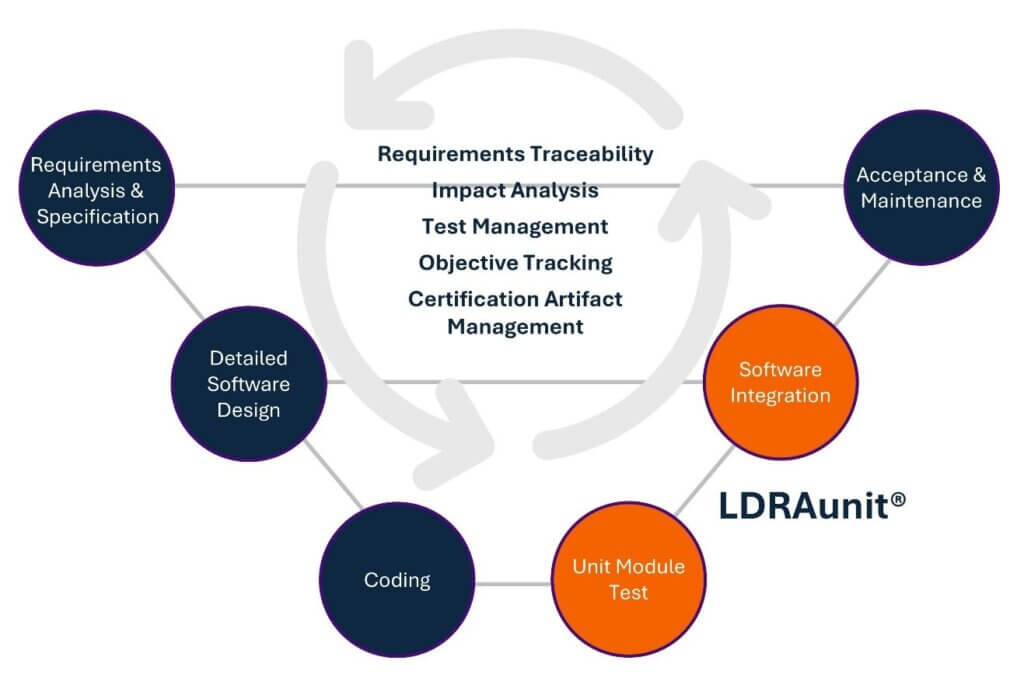
EN 50129 completes the set by specifying the lifecycle activities to be completed before and after the acceptance stage.
To meet these goals, STG selected LDRAunit as its dedicated solution for unit and component testing. A combination of structured test creation, intuitive interface, and reliable code coverage analysis made LDRAunit the ideal fit.

“LDRAunit enabled us to perform component tests in accordance with railway standards and client requirements” said Mariusz Dulski, CEO of STG. “The tool makes it easy to create detailed test case scenarios and to insert custom user code at every stage of the process. This flexibility is crucial when working with legacy or complex embedded systems.”
STG’s assurance strategy was grounded in the RAMS lifecycle set out in the EN 50126 family of standards. STG applied a disciplined approach fully consistent with recognised software-assurance expectations, and the structured unit-testing capabilities of LDRAunit aligned naturally with this methodology.
Ease of integration was another decisive factor. STG’s client required use of a field-proven, certifiable test suite, and LDRAunit’s established pedigree in safety-related domains provided confidence for both supplier and customer. The tool’s compatibility with existing workflows also reduced setup time and avoided disruption to the established testing process.
LDRAunit’s structured approach allowed STG to systematically verify each software component against design intent and functional requirements. Automated test execution and coverage analysis provided clear, reproducible evidence of verification activities – a key advantage in regulated sectors.
The team particularly valued the ability to visualise coverage data and track progress at a granular level, enabling engineers to identify untested paths and confirm complete verification of critical functionality.
By aligning with LDRAunit’s methodology, STG could ensure traceability from individual test cases to the overarching safety objectives defined under EN 50126. This not only strengthened project assurance but also positioned the company to demonstrate rigorous compliance to clients and certification authorities alike.
For STG, the introduction of LDRAunit has reinforced its reputation as a capable, standards-driven testing partner. The company’s emphasis on quality, safety, and efficiency aligns closely with LDRA’s own philosophy of software verification excellence.
While the team has not quantified a formal return on investment, the practical benefits are clear. LDRAunit’s structured testing environment has streamlined the creation, execution, and documentation of component tests, helping STG deliver trusted results under demanding certification conditions. Along the way, STG’s engineers have also shared valuable suggestions for further refinement, such as simplifying variable management between test cases and enhancing flow-diagram visualisation. LDRA welcomes such feedback as part of its ongoing commitment to continuous product improvement and collaboration with users in the field.
As Mariusz Dulski summarised, “We chose LDRAunit because it meets the standards our clients expect, supports our workflow, and lets us focus on what matters most – proving that embedded systems work safely and reliably in the real world.”
With LDRAunit firmly established in its testing toolkit, STG is well-placed to expand its services across the growing field of railway and safety-critical systems. The company’s experience demonstrates how the right tool – applied with expertise and diligence – can bridge the gap between compliance requirements and practical engineering realities.
In an industry where precision is everything, LDRAunit has helped STG keep its testing firmly on track.
Email: info@ldra.com
EMEA: +44 (0)151 649 9300
USA: +1 (855) 855 5372
INDIA: +91 80 4080 8707
