The IIoT market is expected to grow from USD 77.3 billion in 2020 to USD 110.6 billion by 2025, at a CAGR of 7.4% during the forecast period (2020-2025), as per the report by Markets & Markets1. The growth of the IIoT industry is driven by factors such as technological advancements in semiconductor and electronic devices, increased use of cloud computing platforms, standardization of IPv6, and support from governments of different countries for R&D activities related to IIoT.
The year 2020 was remarkable for all industries, including Industry 4.0. COVID-19 lockdown has led to new ways of Industrial Automation & Robotics as well as connectivity. Earlier in 2020, we never thought that we could carry out plant activities using remote access virtually. Now, we can directly access conveyor lines, production lines, stores, QA/QC lines and practically everything virtually.
The rapid growth of the IIoT industry and increased connectivity bring together the challenges for functional safety & cybersecurity, as traditionally, these systems were not designed keeping functional safety & cybersecurity requirements in mind. Therefore, it is crucial to identify and document functional safety & cybersecurity requirements early in the product development lifecycle and ensure that subsequent development artifacts are evaluated for compliance with those requirements.
Requirement traceability is an important aspect of requirement engineering. It focuses on ensuring that all the requirements have been met from planning, creation, maintenance, and use, with the ability to follow and check the life cycle of requirements in both forward and backward direction. In addition, traces and links should be maintained and used in the development process to keep track of different artifacts.
The software development model will help explain the phases of the project and how traceability will help in different levels of requirement like High Level Requirement (HLR), Low Level Requirement (LLR), Design, Source Code, Test cases and Test results. If any changes made to requirements, it would cause impacts to the associated test cases and other artifacts. Requirements for a software project is like the foundations of a building.
Requirement Traceability Matrix (RTM) is a document that links and maps user requirements with test cases to validate that all requirements are met via test cases, and no functionalities are unchecked during software testing and delivered at the conclusion of the software development life cycle. And it documents all requirements, tests, test results, and issues. The objective of the Requirements Traceability Matrix is to ensure that all requirements defined for a system are tested in the test protocols and recorded in a single document.
A requirement traceability matrix can:
Importance of Requirement Traceability:
Types of Requirement Traceability Matrix: In Software Engineering, the traceability matrix can be divided into four major components as mentioned below and showcased via. images:
Challenges of Requirement Traceability
Benefits of Requirement Traceability
Standards demand Requirements Traceability: IEC 61508 and IEC 62443 are the widely accepted standards for functional safety and cybersecurity for industrial IoT systems, respectively. We are listing out some of the clauses related to requirements traceability below.

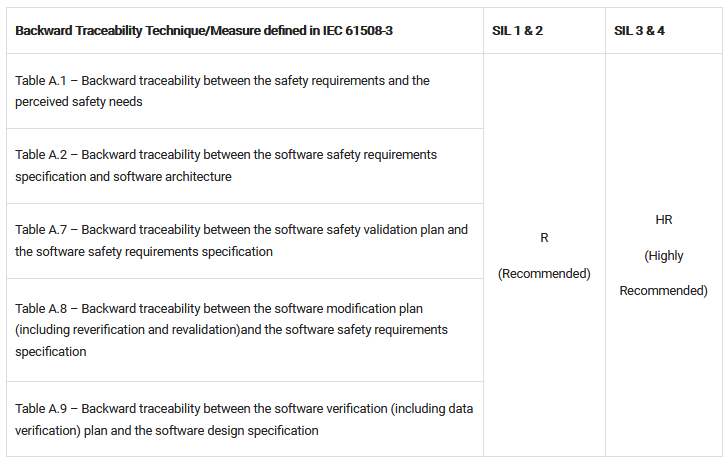
Additionally, reference can be made to IEC 61508-6 Annex E, where two worked examples are given of SIL 2 & SIL 3 applications. It is illustrated how the above examples of forward & backward traceability can be selected/interpreted for these two SIL 2 & SIL 3 applications.
Clauses defined in IEC 62443-4-1:2018:
Clause 3.1.14 demands traceability throughout the lifecycle.
Clause 5.2.1b demands requirements definition with requirements traceability.
Clause 8.3.1d demands review of security implementation and traceability to the security capabilities defined to support the security design.
Conclusion:
Requirement Traceability is crucial to identify and document functional safety & cybersecurity requirements throughout the product development life cycle. To improve this process in the Industrial IoT system, we must focus on 360-degree requirement traceability. Standards such as IEC 61508 and IEC 62443 also demand requirement traceability. It is also essential to document functional safety and cybersecurity requirements throughout the life cycle and evaluate final artifacts for compliance.
References:
https://www.marketsandmarkets.com/Market-Reports/industrial-internet-of-things-market-129733727.html
https://www.softwaretestinghelp.com/wp-content/qa/uploads/2018/06/Bi-Directional-Traceability.jpg

Chandana Kanth, Technical Consultant, LDRA India
With a Bachelor of Engineering in Information Science and Engineering from VTU, she started her career as a Software Engineer at Softtek India Pvt Ltd. As an FAE in LDRA, she is involved in integrating the development tools, debuggers and testing tools in the embedded domain. She has worked on the LDRA tool suite, point products, plugins and TLPs with the LDRA tool and is actively involved in technical support in assisting various customers.

Akshay Dixit, Sr. Account Manager, LDRA India
Akshay completed his MBA from Solapur University in 2012 and has more than 8 years of experience in industrial sales. He is currently handling India’s western region sales for LDRA. Before joining LDRA, he worked in the certification, testing and inspection industry for five years.
https://industrialautomationreview.com/360-requirements-traceability-a-need-for-industrial-iot-systems/ (published on Dec 6, 2021)
Email: info@ldra.com
EMEA: +44 (0)151 649 9300
USA: +1 (855) 855 5372
INDIA: +91 80 4080 8707